The Power of Extreme Ownership
Feb 07, 2026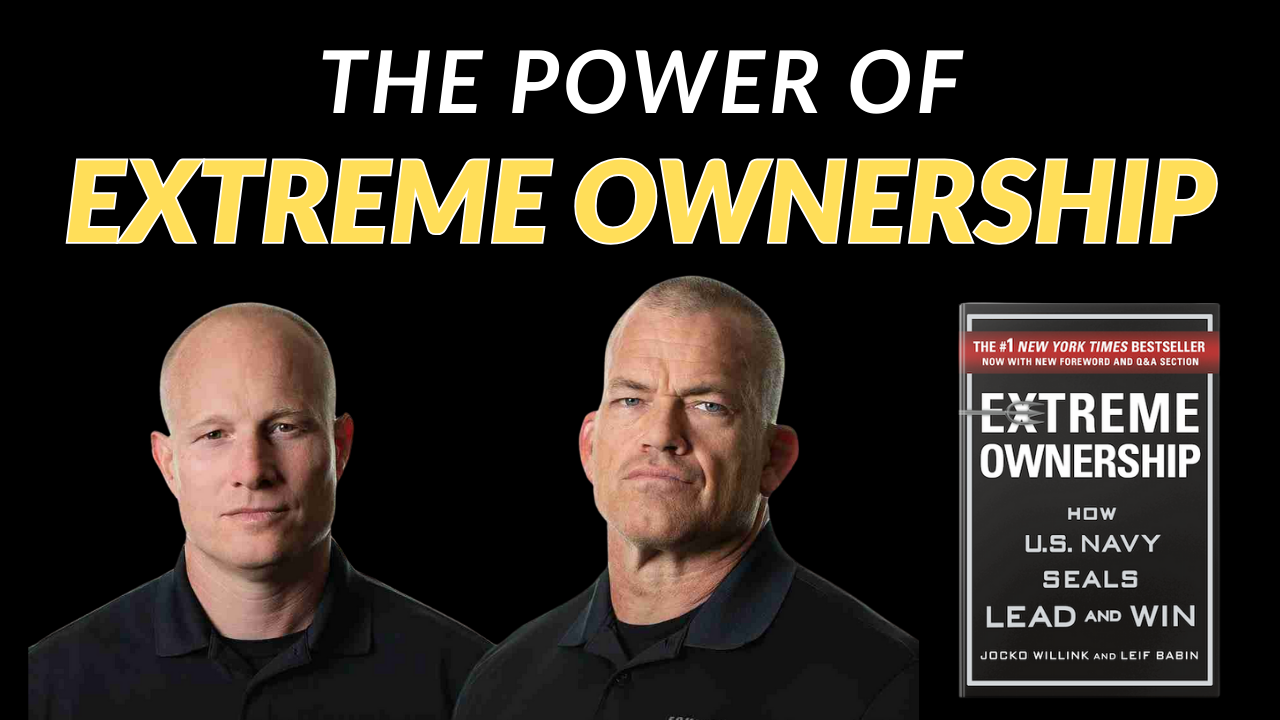
Books Referenced
Extreme Ownership - Jocko Willink and Leif Babin
The Dichotomy of Leadership - Jocko Willink and Leif Babin
How many leaders have you worked for that make you think, “I would go work for them again!”
1?
2?
Maybe more?
Compare that number to the total volume of managers and leaders you have worked for.
If you work in a space where reorgs are common, and job shifts are a yearly occurrence, then you have worked for your share of leaders.
Most of them do not leave a memorable mark on us. But some do.
There are a variety of reasons why leaders leave their mark: they care, they make us feel important, they have a compelling vision… there are many more reasons.
There is one reason that I want to highlight today: Ownership.
This single variable not only impacts how we perceive leaders, but it directly impacts their success and growth over time.
You see, most leaders don’t fail because they lack talent or skill. Most leaders are plenty skilled.
They fail because they outsource responsibility. They shift blame. They avoid taking ownership.
They might blame the team, the market, the timeline, the circumstances. Anything but themselves.
And I get it.
I’ve worked in fast-paced and high-pressure environments. There are certain things you can’t control.
You can’t control the market, your team’s work ethic, the weather.
But when leaders do not take ownership, they lose the ability to change, to take action, and therefore win.
(This obviously goes for non-leaders too. Most people fail because they don’t take responsibility.)
In this article, I’m going to teach you how to take Extreme Ownership, ****and why it’s one of the most powerful leadership principles you can adopt.
And yes, this is based on the book by the same name, written by Navy Seal Commanders Jocko Willink and Leif Babin.
By practicing Extreme Ownership, you’ll see:
- Clearer decision-making
- Faster execution
- Stronger trust with your team
- Less frustration and finger-pointing
Avoiding ownership leads to predictable outcomes:
- Confusion about priorities
- Silos and politics
- Missed deadlines
- Teams waiting instead of acting
Extreme Ownership is a practice every person can adopt to achieve more. But as a leader, Extreme Ownership should be a requirement.
In the book, there are 12 principles around this topic, but the below 3 are my favorite.
Principle 1: Extreme Ownership - Take responsibility for everything in your world
Extreme Ownership means this: If something goes wrong, you own it. Period.
Not because you caused every issue, but because you are responsible for the outcome.
This is where people first reject this idea.
They say, “But I didn’t cause this problem, how could I possibly take ownership over it?”
This is the wrong question to ask.
Of course, you are not the literal cause of everything that goes wrong… but taking extreme ownership means you recognize you are responsible for the solution.
If something is your fault, you own it.
If something is not your fault, you first consider how it might be your fault, then you own it.
This principle is uncomfortable. It is uncomfortable to admit our own shortcomings and mistakes. It is uncomfortable to look at other people’s mistakes and say, “I’m responsible.”
But consider what happens if you don’t take ownership.
You spend time looking for blame. You spend time seeking the root cause (more blame). You spend a lot of time NOT creating a solution. You end up looking for answers everywhere but in the mirror.
Not only is this practically inefficient, but this behavior also eats away at leadership trust.
Any time you dodge responsibility, your team thinks, “They’re just looking for someone to blame.”
ANY time a leader shifts blame, it makes them appear weak.
When leaders take ownership:
- Problems get solved instead of explained
- Teams feel protected, not blamed
- Learning replaces defensiveness
Taking Extreme Ownership doesn’t mean self-criticism and beating yourself up. That would be time wasted. It means asking better questions:
- What could I have done differently?
- Where did I fail to set clarity or expectations? (this is a HUGE question more leaders should ask)
- What’s my next move?
Ownership shifts power back to the leader. Ownership gives the leader control. Ownership gives the leader agency.
If it’s your responsibility, you can fix it! This should be an empowering thought and belief. Not one that scares you.
Principle 2: Decentralized Command - Trust others to lead
You are a leader. But guess what, SO ARE OTHERS!
Extreme Ownership does not mean doing everything yourself. In fact, trying to control everything destroys execution.
(Speaking of ‘trying to control everything,’ the first book actually received a lot of questions about OVER ownership as the pendulum had predictably swung very far to the on this topic. They wrote a follow-up book called The Dichotomy of Leadership to address how extreme ownership does not mean over-ownership.)
Decentralized Command means that everyone understands the mission. Everyone also understands their role and responsibilities. Then you set the expectation that decision-making happens at the lowest possible level.
Why this matters:
- Speed increases
- Bottlenecks are removed
- People feel trusted and capable
As a leader, your job is not to have all the answers. Your job is to create clarity, then empower others to act in alignment with that clarity.
If your team can’t make decisions without you, then you are not leading… you are a crutch.
As a leader, you own the direction. You own the vision. You own the intent.
But if you own everything, what does anyone else do? Well, they stand around waiting for you to make all the decisions. As decisions pile up, speed decreases and YOU become the bottleneck.
Strong leaders don’t hoard authority. Instead, they distribute it intentionally.
Now, inevitably someone is going to make a bad decision. In that scenario, who takes responsibility?
Yeah… YOU.
Why? Because you are the leader. And because of principle 1: Extreme Ownership. You are the one who granted permission (set the expectation) that the erring individual makes the decision.
This gives you an opportunity to coach that individual. It is also an opportunity to reflect on how you create and expectations with your team.
Again, not taking ownership will destroy other’s trust in you.
You take the blame. You own it. You fix it. And you build your leadership capability as a result.
This is why leadership is not for the weak.
But I believe in you.
I’ve spoken about trust a couple times now. This leads me to my 3rd favorite principle in the book.
Principle 3: Cover and Move - Win together or not at all
This principle is simple but rarely practiced. It happens because organizations often are stuck in silos. Some organizations have internal teams that actually compete with each other. Microsoft was notorious for this in the pre-Satya Nadella era.
But here is an obvious fact: Teams succeed when they support each other, not compete with each other.
This sounds ridiculous to say out loud, but sometimes the most impactful principles are the most obviously stated.
Jocko and Leif discuss Cover and Move from a military perspective. As a military practice, cover and move is when one part of a group looks for threats (and may lay down fire) while the other part moves across ground. Those who are moving are trusting the others to cover them… to protect them!
In leadership, Cover and Move means this: There is only one team. That team wins together or fails together. There is no us vs them within a team, organization, or business.
You are all in it together.
As mentioned above, Microsoft was notorious for different teams competing to ship the same products. It led to infighting, hiding information, duplicate work, and wasted time/money. But Microsoft made a specific change once Nadella took the reins from Steve Balmer. He implemented an internal rallying cry: One Microsoft. And he meant it. Duplicate work was sought out and reorganized. Teams shifted. Priorities changed. The whole company slowly but surely realigned to this principle. Since that time, Microsoft’s stock price has 10x’d.
I could write a dozen pages on why Cover and Move is an important principle. But let me highlight 2 reasons in particular.
First: Problem diagnosis. When this principle is enabled and everyone is working together, problem diagnosis becomes clearer. When teams fail to support one another, leaders often misdiagnose the problem as a people issue when it’s really a systems issue. The people are doing the best they can with the tools they have. If they are being rewarded for NOT working together (because different divisions have competing goals), then they are operating within a faulty system. When everyone is working together, THEY can help you identify the issue. Maybe there is a skill gap. Maybe there is a system issue. Maybe there is a clarity problem. Are the incentives aligned? Does the leadership team model collaboration or rivalry?
Second: Trust. Teams that trust each other move faster and in tighter alignment. They share information and resources. They all understand the mission and who is responsible for what. When teams don’t trust each other, they do not communicate clearly, share information, or support each other. This is obviously inefficient and detrimental to the team’s goals.
Cover and Move reminds us that leadership is not about individual performance. It’s about collective execution.
If one part of the system fails, the whole system suffers.
The Wrap Up
Extreme Ownership changes how you lead, how you see yourself, and how others see you.
It gives you control and agency. It builds trust.
If you want to read more about these principles and learn about 9 more, the book Extreme Ownership is worth adding to your shelf. Also, the follow-up book The Dichotomy of Leadership is also a worthy read. I reread these two every year!
Extreme Ownership is not about being harsh on others, or even yourself. It is about holding yourself to a higher standard. It’s about being effective.
When you own everything in your world, you acknowledge your ability to change it.
When you seek to blame, nothing will change.
Taking ownership is the only way to move forward.
So, my friends. Look in the mirror. Where are you avoiding ownership? Where do you catch yourself saying, “That’s not my fault?” Where can you take responsibility?
Thanks for being here.
I’m rooting for you
Clark